
Last updated September 20, 2026
Free on-site gate assessment - hinges, posts, and your LiftMaster or Nice gate operator checked before anything is quoted
The assessment is free and the quote is the invoice.
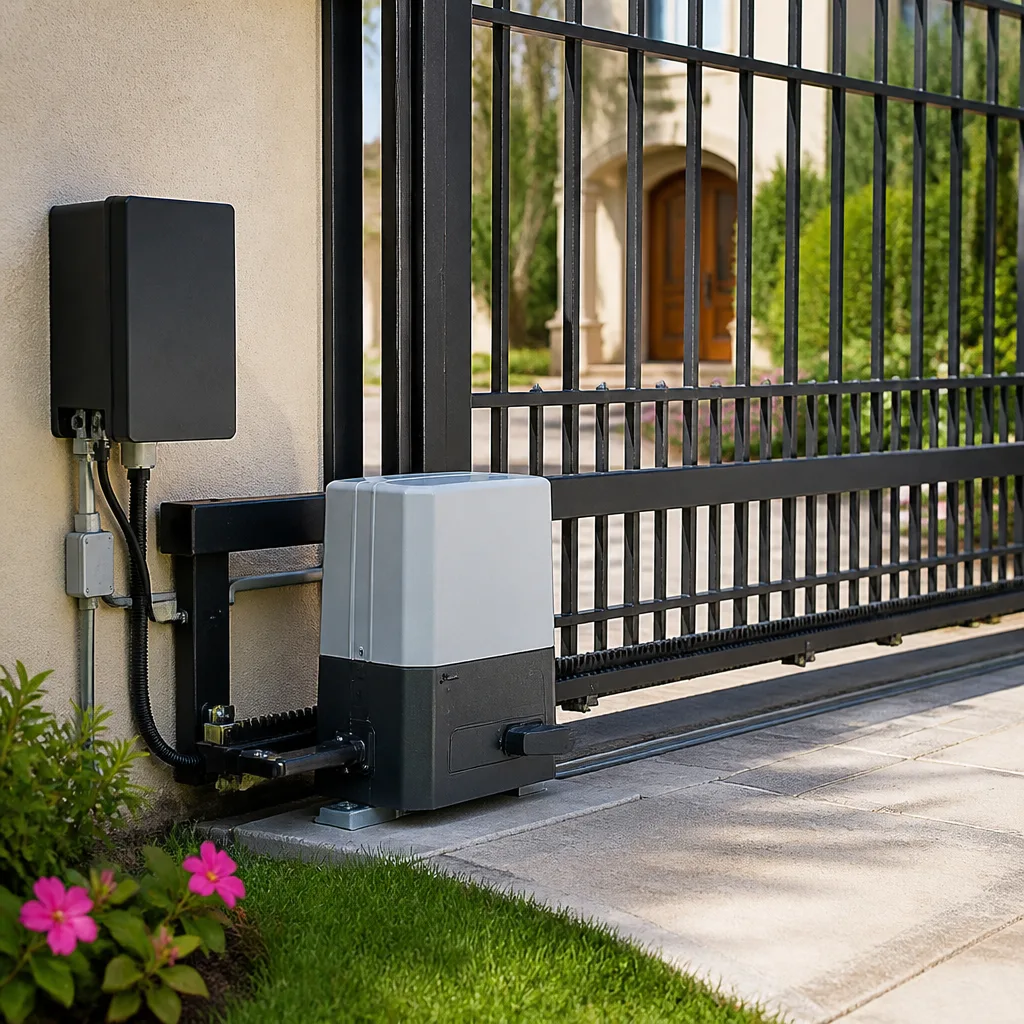
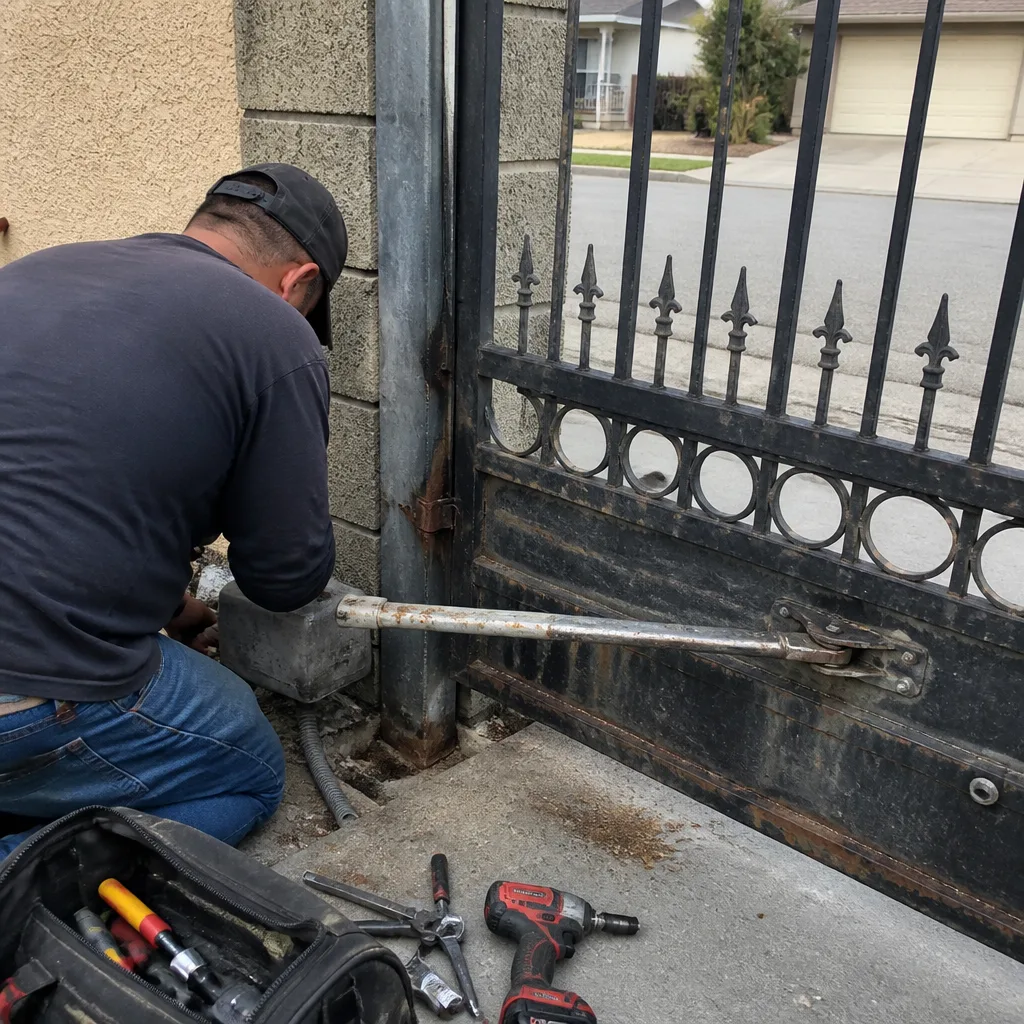 Before
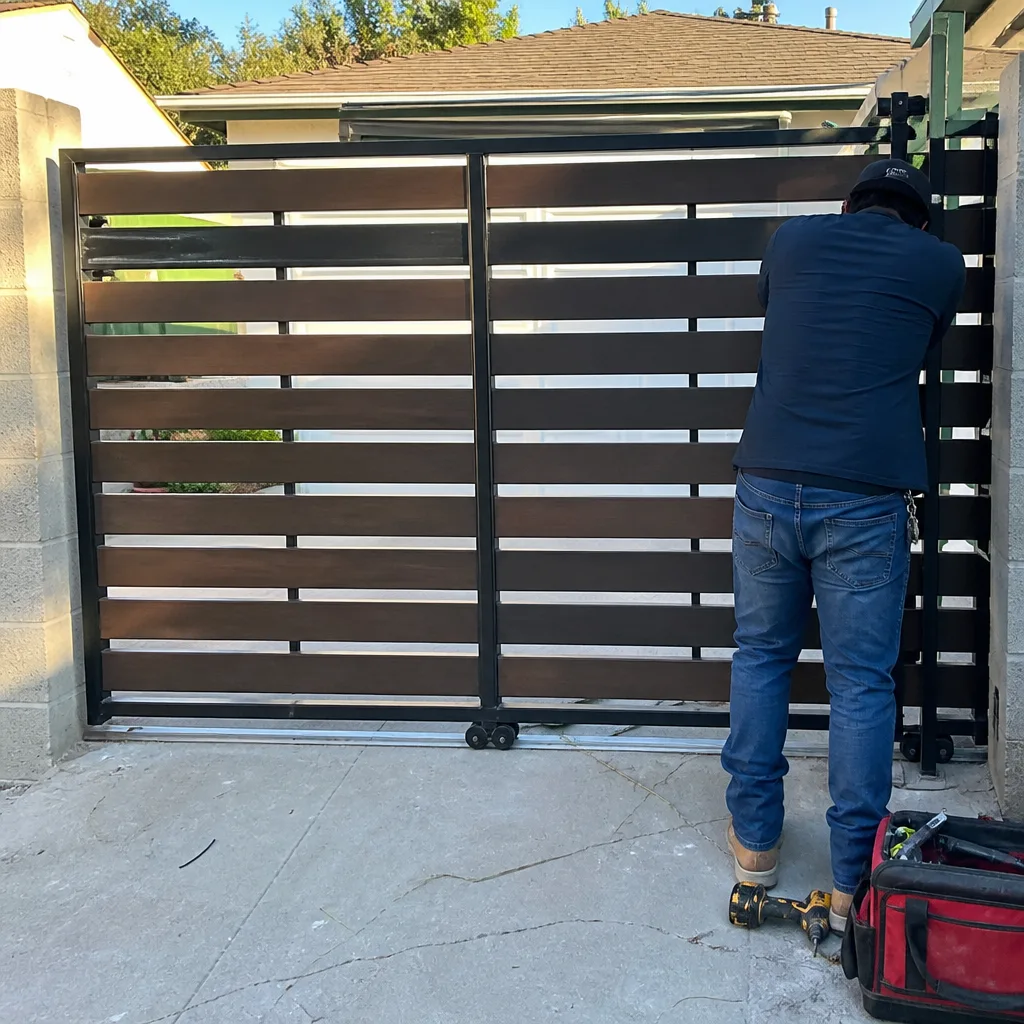 After
After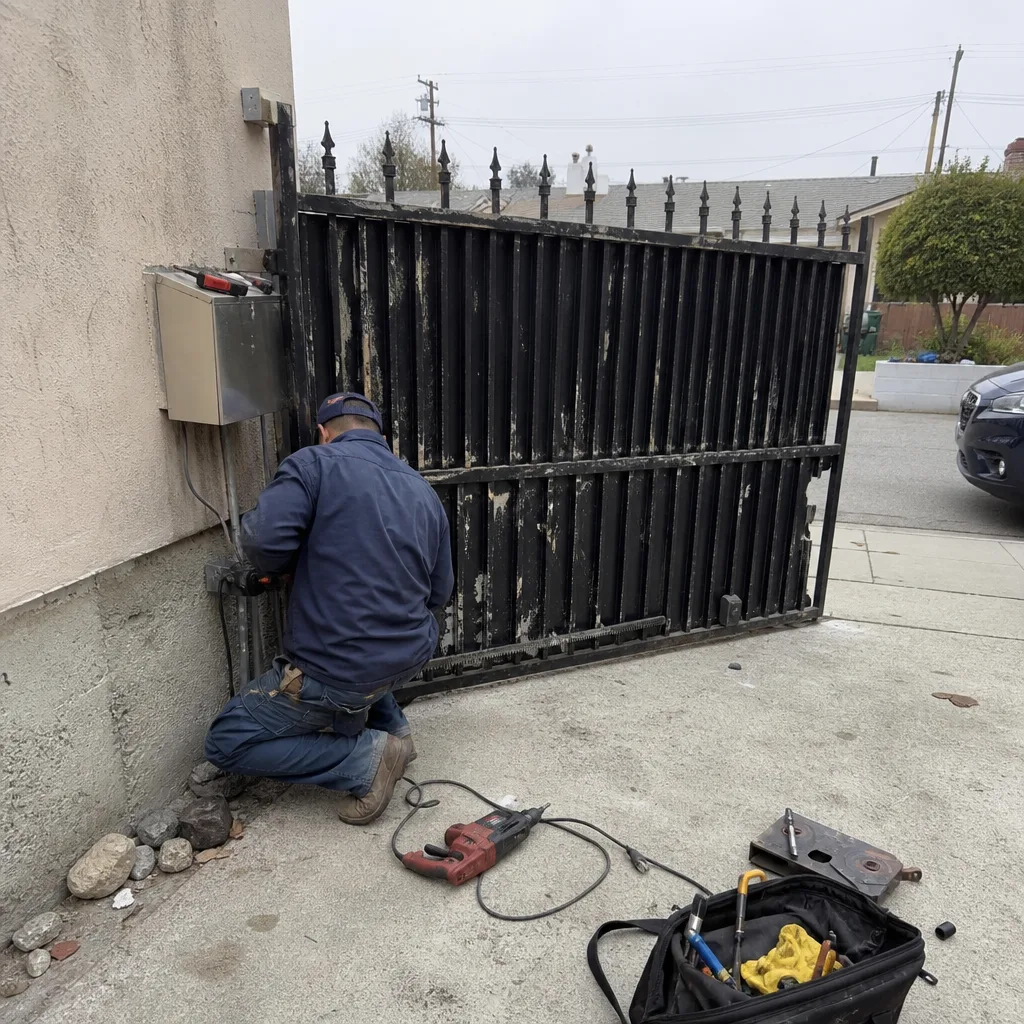 Before
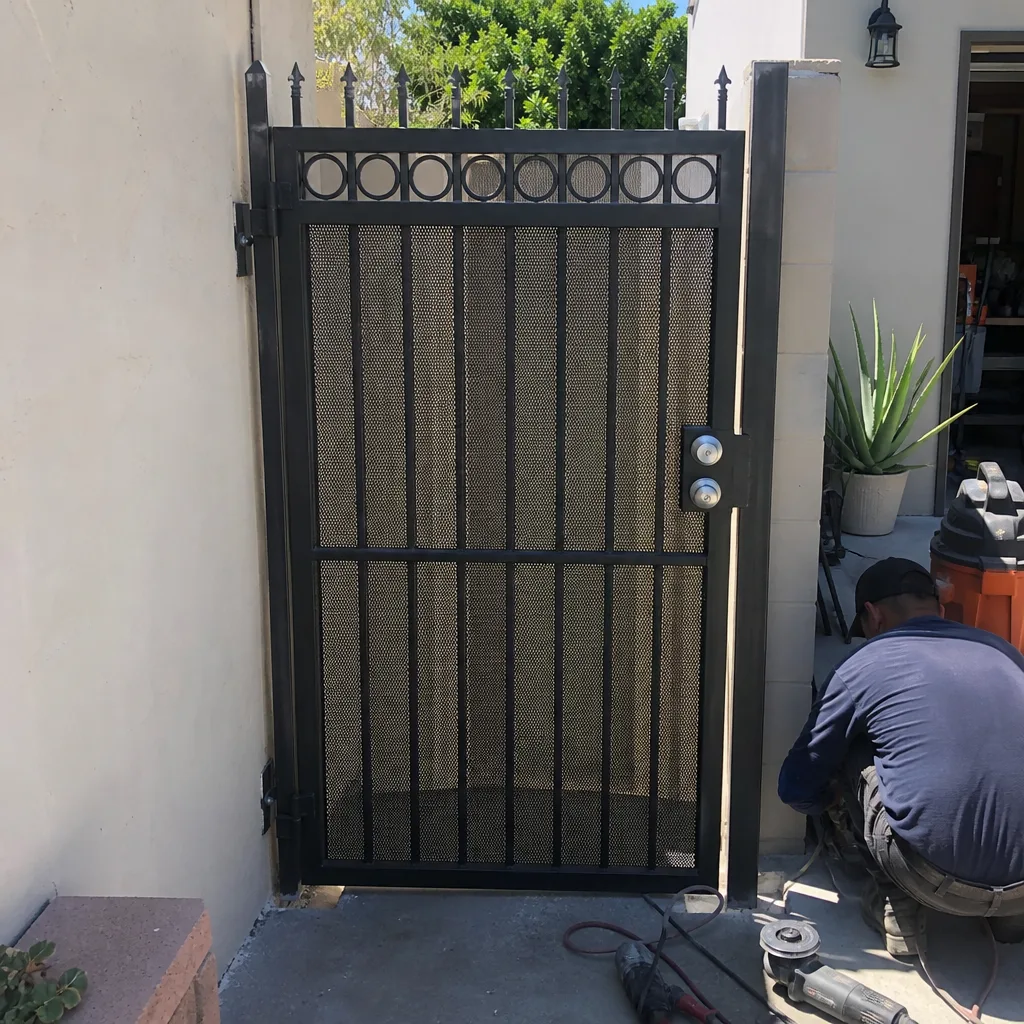 After
After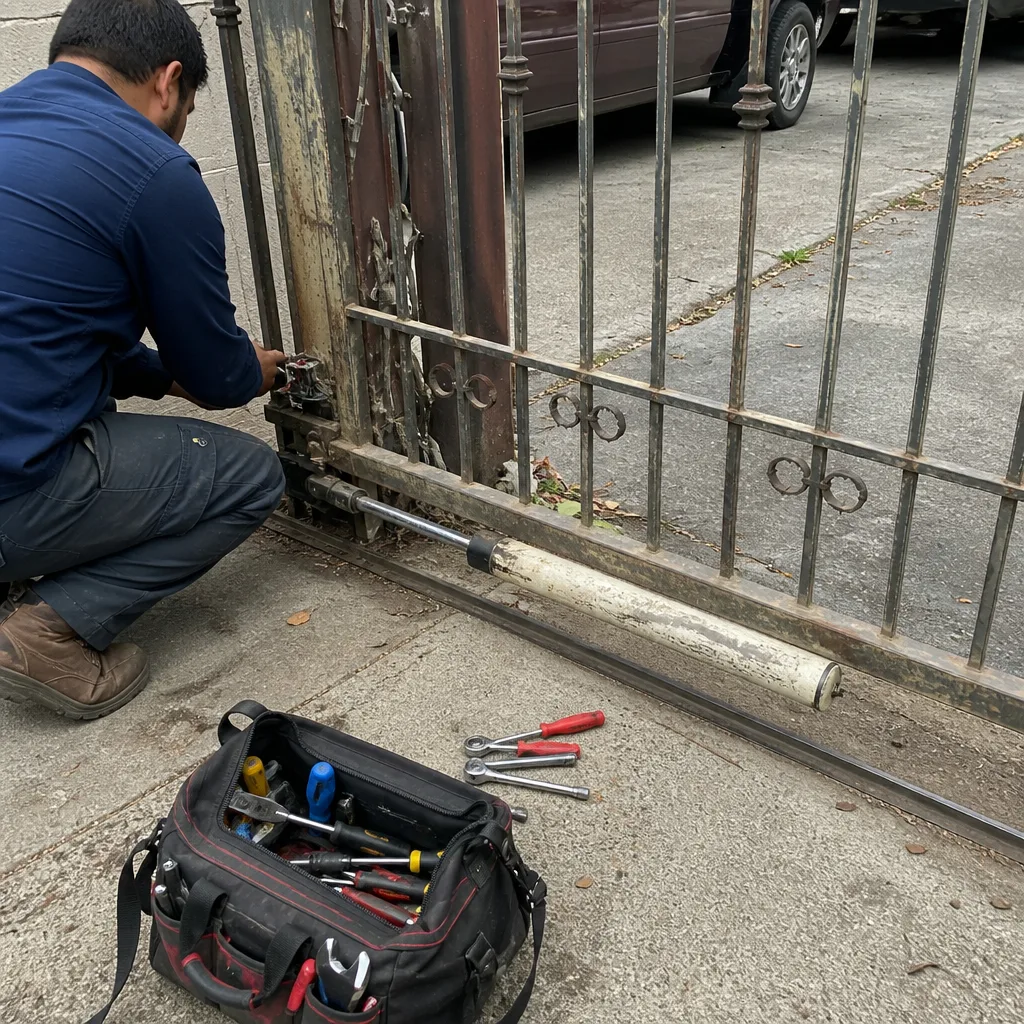 Before
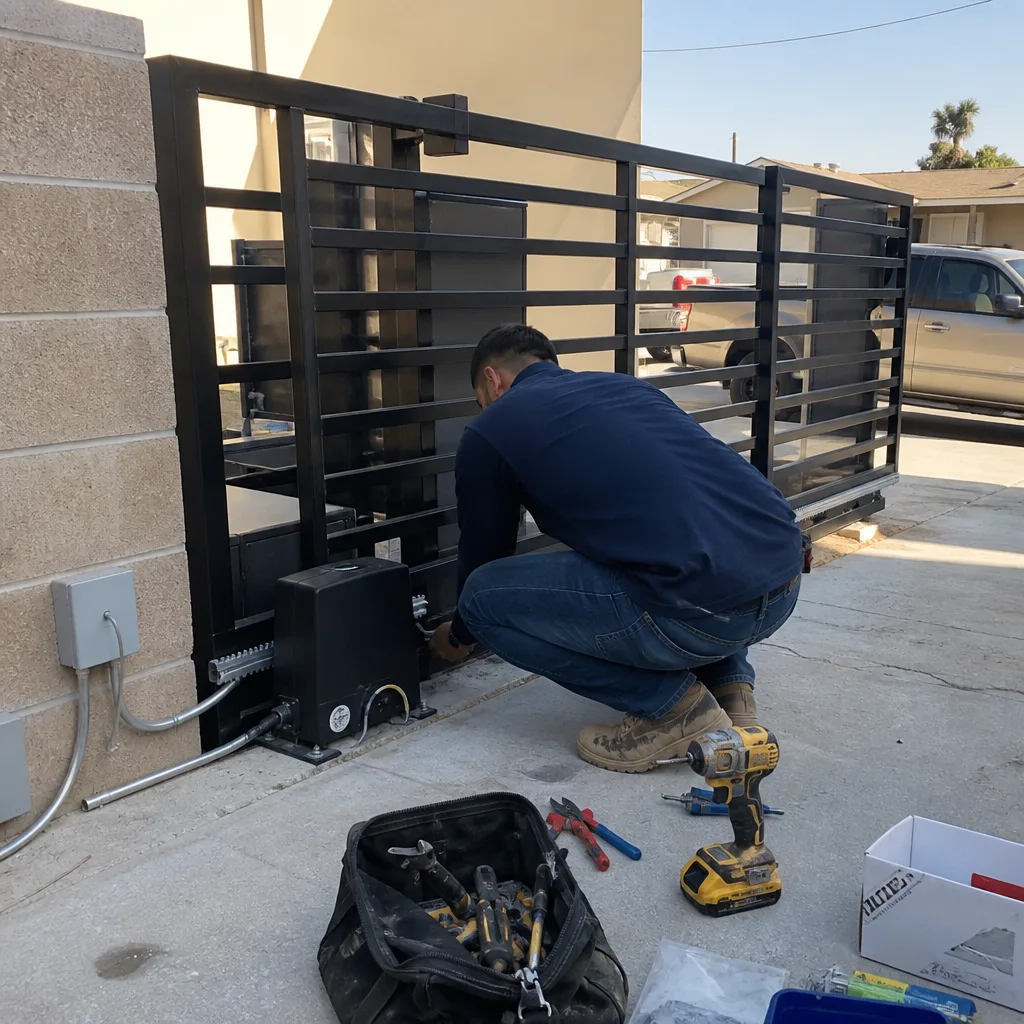 After
AfterGate Repair Warning Signs: A Inglewood Homeowner’s Reference Guide
A gate that hesitates for two seconds before moving isn’t a minor annoyance. It’s a gearbox reporting that it has between 30 and 90 operating cycles left before it stops entirely. We’ve spent more than a decade watching Inglewood gates fail in predictable sequence, and the pattern is always the same: the gate tells you what’s wrong, in its own language, weeks or months before the actual breakdown. This guide teaches you how to read that language, what each signal costs to address while it’s still cheap, and which signs mean “schedule a visit this week” versus “stop using this gate tonight.”
Quick Answer
The most common gate repair warning signs in Inglewood are hesitation before movement, grinding or metal-on-metal scraping, partial travel (the gate stops partway), reversed direction mid-cycle, and a motor that runs but doesn’t move the gate at all. For more guides & resources on identifying these issues, explore our blog. Each symptom maps to a specific component - gearbox, hinge, limit switch, photo-eye, or drive chain - and most can be repaired for $180-$450 if addressed before the component fails completely. Waiting until the gate stops entirely typically triples the repair cost because collateral damage spreads to adjacent parts.
Table of Contents
- The Sign-to-Component Map: What Your Gate Is Actually Saying
- Schedule It or Stop It: How to Classify Any Warning Sign
- The Three Signs Inglewood Homeowners Dismiss Most Often
- How to Photograph and Describe a Warning Sign Over the Phone
- What the Diagnostic Log Says vs. What Your Eyes See
- Inglewood-Specific Factors That Accelerate Gate Wear
- What Each Warning Sign Typically Costs to Fix
BeforeAfterThe Sign-to-Component Map: What Your Gate Is Actually Saying
Gates don’t make random noise. Every sound, pause, and irregular movement is a specific component reporting its condition. Learning the map between what you observe and what’s actually happening inside the mechanism is the single most useful skill for an Inglewood homeowner with an automated gate, because it lets you decide whether you’re looking at a $40 hinge job or a $1,200 motor replacement before you even pick up the phone.
Hesitation Before Movement (2-5 Seconds)
When you press the remote or keypad and the gate waits before responding, you’re hearing the control board or the capacitor working harder than it should. In residential swing gates, the two-second delay is usually a capacitor losing its ability to deliver the startup current the motor needs. In slide gates, the same hesitation often points to a drive chain that has stretched beyond its tension range. Either way, the component is telling you it’s operating at the edge of its capacity. The repair window on this one is measured in weeks, not months. A capacitor replacement in Inglewood typically runs $120-$180 including the part and the service call. A stretched chain adjustment is about $85-$150 depending on access.
Grinding or Metal-on-Metal Scraping
Grinding is the gearbox or the rack-and-pinion interface losing its lubrication or its tooth profile. Swing gates that grind during travel usually have a gearbox with insufficient grease, which happens naturally over 5-8 years of Inglewood temperature swings. Slide gates that scrape are often running on wheels or a track that’s out of alignment, which drags the rack across the pinion at an angle. This is not a sign to ignore. Once the gear teeth start wearing unevenly, the damage accelerates geometrically. A gearbox re-grease and inspection runs $95-$140. A gearbox replacement, once the teeth are gone, runs $350-$700 depending on brand. The scraping noise is the cheapest warning on this list - act on it first.
Partial Travel: The Gate Stops Partway
A gate that opens halfway and stops, or closes two-thirds and reverses, is reporting a limit-switch problem or an obstruction-detection problem. The limit switches - small mechanical or magnetic stops that tell the motor when to quit - drift out of position over time, and when they do, the gate’s “full open” or “full closed” position moves with them. You’ll see the gate consistently stopping at the same wrong spot, which is the key diagnostic clue: consistency means limit switch, inconsistency means obstruction sensor. Limit switch adjustment is a $90-$130 repair and takes about 45 minutes on most LiftMaster, FAAC, and BFT units. If you keep forcing the gate past the wrong stop position with the manual release, you’ll bend the gate frame or tear the bracket, and that’s a $400+ welding job.
Reversed Direction Mid-Cycle
The gate starts closing, then suddenly reverses and opens again. On a gate with photo-eyes - the infrared beam across the gate opening - this is usually a misaligned beam or a dirty lens. The gate thinks something is in the path, so it reverses as a safety response. This is the “good” version of the problem. The “bad” version is a sensitivity setting on the motor’s obstacle-detection circuit that’s drifted too high, so the gate reverses against nothing because it’s sensing resistance in its own drive train. That resistance is often a failing bearing or a stiff hinge that the gate interprets as an obstruction. We’ve seen Inglewood homeowners with this symptom go months thinking the gate was “just being cautious” while a $35 bearing was grinding the drive shaft down. Inspect the photo-eyes first - a lens cleaning is free - but if the reversal persists with clean, aligned beams, call someone who can read the motor’s sensitivity values. This is one of the warning signs where the diagnostic log (if you have one) gives you the answer faster than your eyes will.
Motor Runs But Gate Doesn’t Move
You hear the motor humming, but the gate stays put. On slide gates, this is almost always a broken drive chain or a sheared sprocket key. On swing gates, it’s usually a stripped gear or a failed coupling between the motor shaft and the actuator arm. The motor is fine - it’s doing its job - but the mechanical connection between the motor and the gate has failed. This is the most dangerous of the “still running” signs because the motor can overheat and burn out if you keep pressing the button while the gate is bound. A failed coupling is a $90-$150 repair. A burned-out motor - which happens after about 20-30 forced attempts - is $400-$900 depending on the operator brand. If you hear the motor and the gate isn’t moving, stop pressing the button immediately and put the gate in manual release mode.
This map covers the five most common failure modes we see in Inglewood. For a broader overview of what Gate Repair in Inglewood covers - including gate frame repair, hinge welding, and track realignment - see our full service page. If you’re at the point where the operator itself needs to be replaced rather than repaired, the Gate Motor & Opener page for Inglewood covers the brands we service and what a replacement typically costs.
Schedule It or Stop It: How to Classify Any Warning Sign
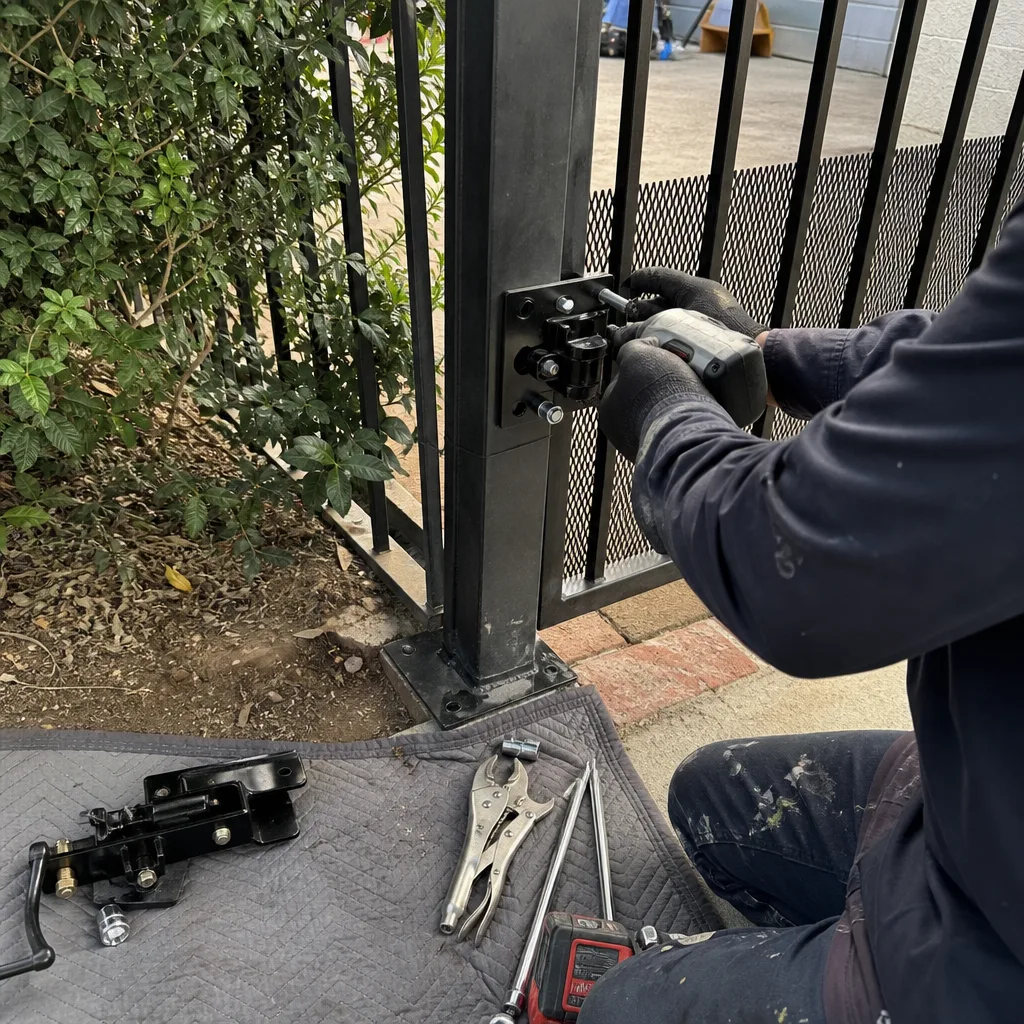
Not every warning sign deserves the same response. Some signals mean “call for an appointment within the next two weeks.” Others mean “put this gate in manual release and stop operating it until a technician arrives.” Here’s the classification framework we use when homeowners in Inglewood call and describe what they’re seeing. It’s the same framework any careful technician uses, and it’s simple enough to apply in your driveway.
Signs You Can Schedule
These symptoms indicate a component wearing out on a predictable curve. You have time - typically two to six weeks - to schedule a visit without risking further damage.
- Consistent, mild grinding that’s been present for less than a month. The gearbox is dry or the chain is loose. It will survive a few more weeks of normal use while you schedule.
- Gate stops at a consistent wrong position. Limit switch drift. Annoying but not destructive in the short term.
- Slow operation, especially when cold. Hydraulic or electromechanical operators slow down as the fluid ages or the capacitor degrades. It’s not urgent, but it’s not going to fix itself.
- Occasional reversal with clean photo-eyes. If the reversal happens once or twice a week and the beams are clean and aligned, you’re probably dealing with a sensitivity setting or a bearing that’s starting to drag. Schedule it.
Signs That Mean Stop Operating the Gate Now
These symptoms indicate either a safety risk or a failure mode that causes collateral damage every time the gate runs. Put the gate in manual release and keep it there until a technician arrives.
- Metal-on-metal grinding with visible metal shavings or dust under the gate. The gear teeth or hinge pins are actively failing. Every cycle makes the repair more expensive.
- The gate slams shut or drops the last few inches. This means the operator’s speed control or dampening has failed, and the gate’s full weight is now driven by gravity. A 400-pound gate moving with uncontrolled force is a serious safety hazard for anyone in the path.
- Motor runs but the gate doesn’t move. Each forced attempt pushes the motor toward thermal failure. Stop pressing buttons.
- Any sign of white or blue smoke, or a burning smell from the operator housing. A capacitor or winding is dead. Disconnect power to the operator immediately.
- The gate moves on its own, without a command. This indicates a control board fault or a short in the external command wiring. An uncommanded gate movement is the most dangerous possible failure. Kill power at the breaker and call for service.
When a homeowner describes a “stop now” symptom over the phone, we prioritize that call ahead of scheduled maintenance work. A live person answers at any hour - including 3 a.m. - because an uncommanded gate or a slamming gate doesn’t respect business hours. If you’re in Inglewood and describing a “stop now” sign, you won’t reach a voicemail box.
The Three Signs Inglewood Homeowners Dismiss Most Often
These are the warning signs we hear dismissed most often during initial calls from Inglewood homeowners - the ones people write off as “just how old gates work” or “it’s always done that.” All three are early-failure indicators, and all three are cheaper to address before the failure becomes obvious.
1. “The Gate Squeaks, But It’s Always Squeaked”
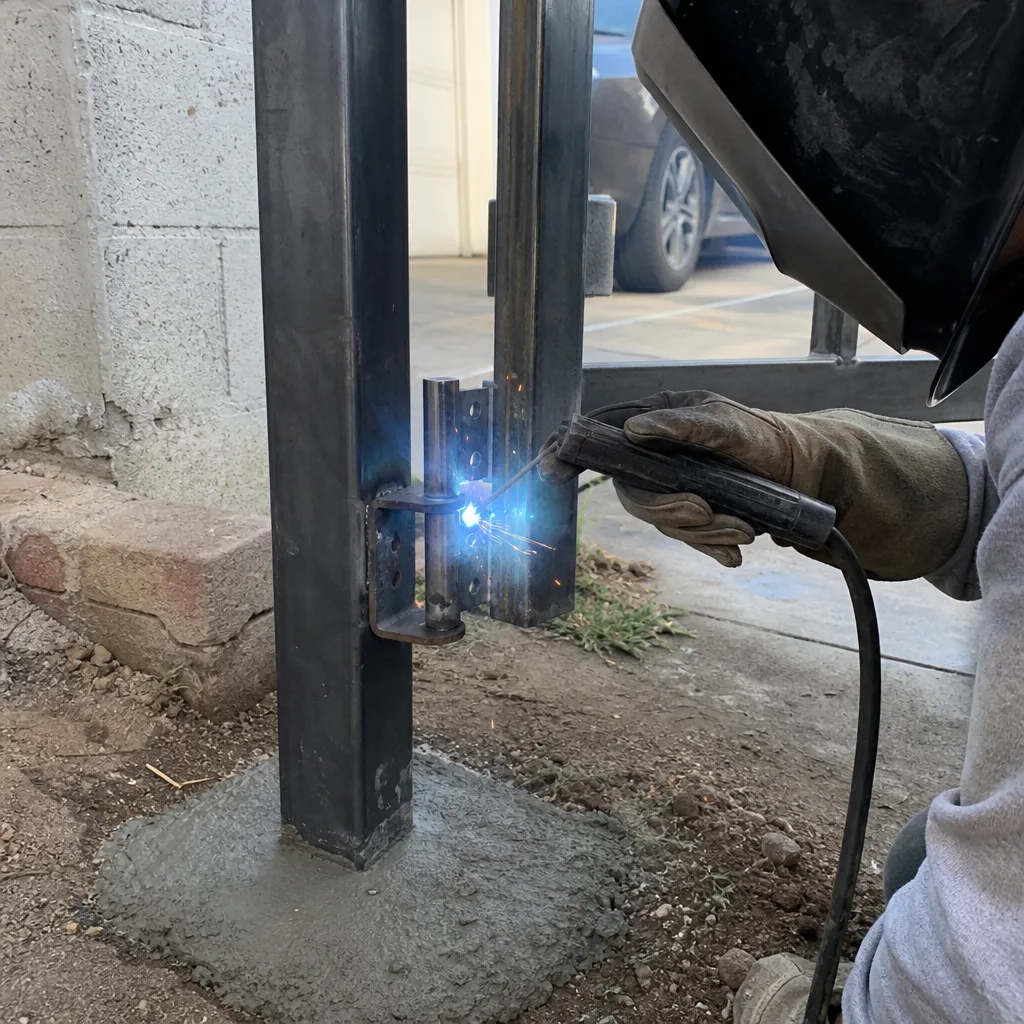
A hinge that squeaks is a hinge without lubrication, and a dry hinge is a hinge wearing against itself. Over time, the hinge pin wears oval, the leaf deforms, and the gate’s weight starts transferring to the operator instead of the hinge post. By the time the squeak becomes a low groan, you’re looking at a hinge replacement and possibly a gate frame repair instead of a $45 lubrication and adjustment visit. The squeak is the cheapest invoice you’ll ever get from a gate company if you call when you first hear it.
2. “The Gate Pauses a Little Before It Starts”
We covered this above, but it deserves repetition because it’s the most commonly dismissed sign in Inglewood. The two-second pause is not a personality trait. It’s the capacitor, which stores the startup charge for the motor, losing its ability to deliver that charge. When the capacitor dies completely - and it will, usually within 30 to 90 cycles of the first noticeable hesitation - the motor won’t start at all. The part costs $20-$45. The service call costs more than the part. The repair takes 30 minutes. Waiting until it fails turns a $150 job into an emergency, and in the worst case, it takes the control board with it when the capacitor blows, which turns the job into a $400-$600 repair. Schedule the fix the first time you notice the hesitation.
3. “Sometimes It Doesn’t Close All the Way, But It Corrects Itself”
An intermittent failure to close fully is almost always a failing limit switch or a power interruption to the control board that corrupts the gate’s “learned” travel positions. The gate’s computer is losing its sense of where “fully closed” is, and it’s compensating on the fly. The problem with “corrects itself” is that it eventually doesn’t. When that happens, your gate will stop at whatever position it decides is closed, which may leave a two-foot gap that’s invisible from the street until someone notices your gate has been open all night. A limit switch replacement is $90-$130. A re-learn of the travel positions is part of that same visit. Don’t wait for the night when it doesn’t correct itself and a raccoon, a stray dog, or worse decides to explore your driveway.
How to Photograph and Describe a Warning Sign Over the Phone
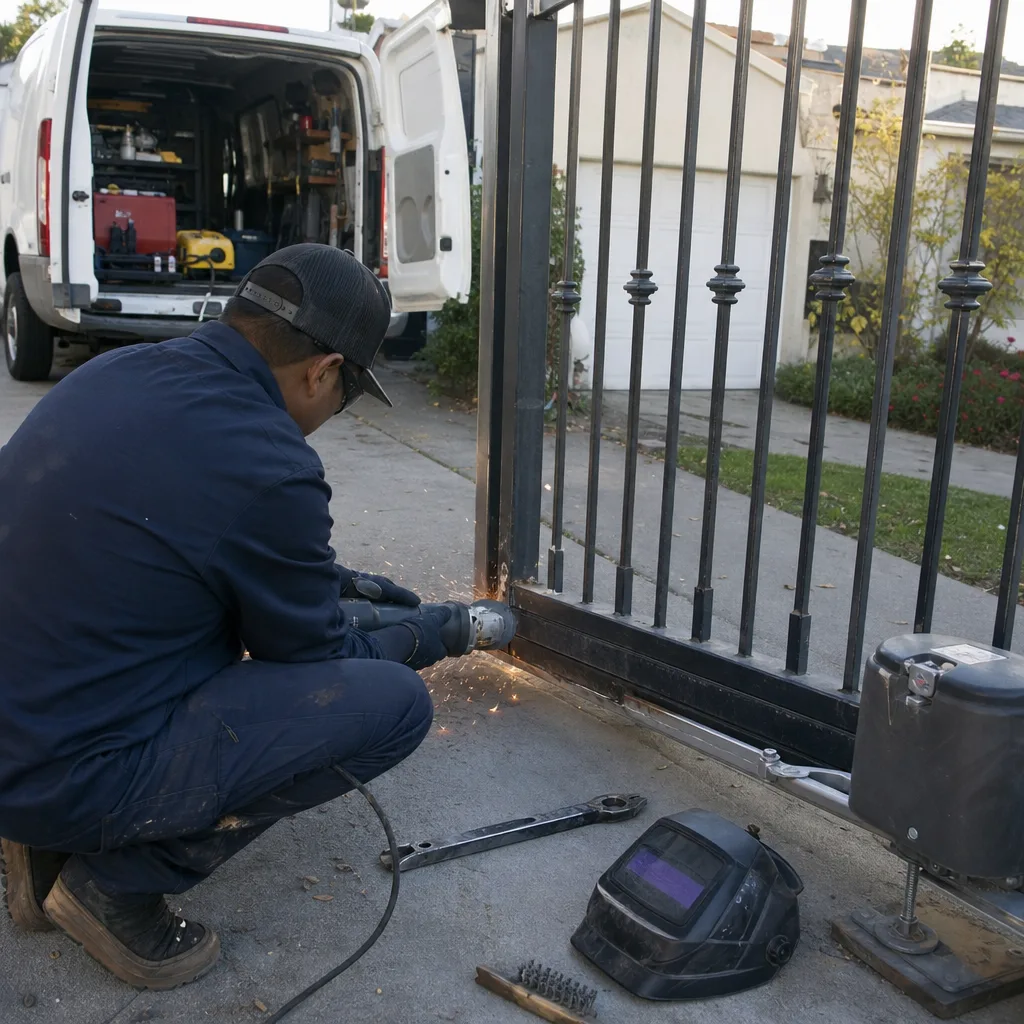
The caller who can describe what they’re seeing and hearing in structured terms gets a more accurate estimate before the technician drives out. The caller who says “it’s just being weird” gets a broad range, because “weird” could mean twelve different things. Here’s the exact method we recommend to Inglewood homeowners who want an accurate phone diagnosis:
- Note the exact moment the symptom occurs. Is it during opening, during closing, or at the start of a cycle? Write down: “When opening from fully closed, it hesitates 3 seconds before moving” - not “it’s slow sometimes.”
- Record the sound. Use your phone’s voice memo app while the gate moves. The technician can identify a gearbox grind versus a chain slap from the audio even over the phone.
- Photograph the operator housing. Open the cover (if it opens without tools) and take a clear photo of the brand label, the model number, and any visible wiring. A technician who knows the exact operator model can quote parts prices before he arrives.
- Photograph the symptom’s location. If there’s visible metal dust under the gearbox, photograph it. If the gate is hanging at an angle, photograph it from the side. If a wheel is off the track, photograph the wheel.
- Test the gate three times and note if the symptom is consistent. Three cycles in a row tells you whether you’re looking at a mechanical issue (consistent) or an intermittency issue (electrical or environmental). Consistency is a huge diagnostic clue.
- Have the gate’s age and the operator’s brand ready. If you know when the gate was installed and what motor drives it (the label photo gives you this if you don’t know), the technician can pin the likely cause to the specific failure mode that brand and age typically produces.
When you call (424) 380-7998 with this information, you’ll get a real diagnosis conversation, not a generic “we’ll send someone out.” That’s the difference between an estimate that’s accurate to within $50 and a quote that balloons once the technician sees the gate in person.
What the Diagnostic Log Says vs. What Your Eyes See
Not all warning signs are visible. Modern gate operators from FAAC, BFT, and Viking include a diagnostic log - a rolling history of events the control board has recorded: the number of cycles, the stall events, the obstruction reversals, the power interruptions, and in some cases the specific error codes that triggered each event. In our experience, fewer than one in twenty Inglewood homeowners knows their gate has this log, and fewer still know how to access it.
The important thing to understand is that what the log records and what your eyes observe often don’t match. A gate that seems to be working normally can have a diagnostic log showing fifteen stall events in the past thirty days - each one a moment when the motor drew excessive current because something in the mechanism was binding. You didn’t see those stalls because the gate compensated quickly and completed its cycle. But the log recorded them, and fifteen stall events in a month means a failing component is loading the motor beyond its design spec.
How to Read an Event Code (Without Being an Electrician)
Most operator brands encode their diagnostics into LED flash patterns or numeric codes displayed on a small LCD panel. The manual that came with your operator - or a PDF from the manufacturer’s site, searchable by your model number - has the decode table. Here’s what matters:
- Event codes for “obstruction” or “reverse” mean the gate has detected something in its path, either real (a car, a person, a trash bin) or false (a sensor out of alignment, a bearing dragging). More than one obstruction event per week on a gate with a clean, clear path is a false-positive problem that needs diagnosis.
- Event codes for “stall” or “overcurrent” mean the motor hit an amp draw above its normal range. This is the single most useful warning sign in the log because it usually precedes a mechanical failure by weeks. A stall event that you never noticed visually is your gate reporting a failing component before the component fails.
- Event codes for “power loss” are common in Inglewood during the summer brownout season and the winter wind storms. Multiple power losses can corrupt the travel limits, which is why gates sometimes “forget” their positions after a string of outages. If your gate suddenly starts stopping at the wrong spot after a storm, the limits probably need to be re-learned.
Here’s the disconnect: the naked eye sees a gate that opens and closes. The log sees a gate that stalled eight times in the last three weeks, reversed against phantom obstructions twice, and lost power once. If we’re diagnosing a gate in Inglewood that’s showing early warning signs, the first thing we do after the visual inspection is pull the log and read the event history. It’s the part of the gate’s testimony that the homeowner can’t provide, and it’s the reason a professional diagnosis is worth more than a visual guess. When we leave, that log reading is included in the written record you receive - what the codes said, what we reset, and what we set the new values to.
Inglewood-Specific Factors That Accelerate Gate Wear
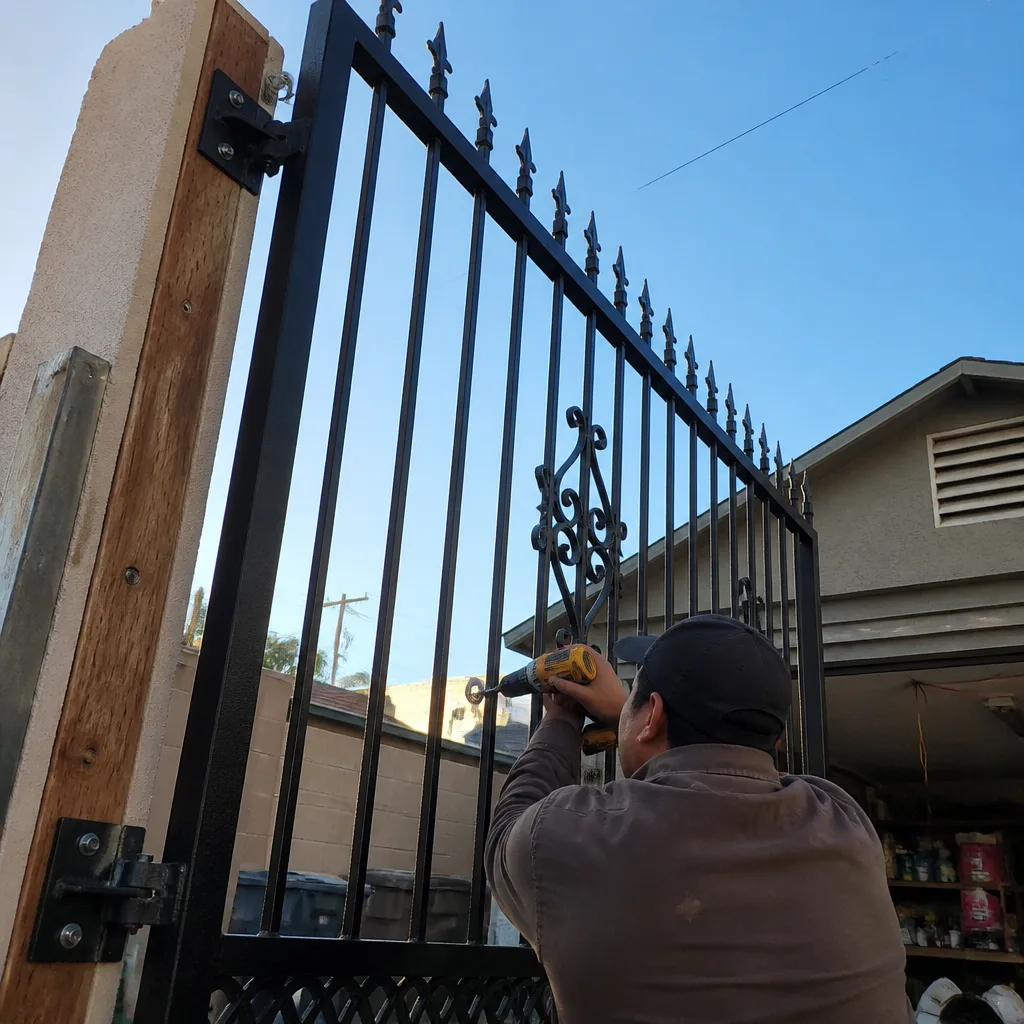
Gates in Inglewood do not age the same way gates in San Diego or Sacramento age. The local climate, the age of the housing stock, and the specific wear patterns we see in the neighborhoods between Century Boulevard and Manchester make a measurable difference in what fails and when. Here’s what we’ve documented in our service records across thousands of Inglewood gate visits.
Heat Cycling and Capacitor Fatigue
Inglewood’s summer temperature swings - cool mornings, 90-plus afternoons, rapid evening cool-downs - put stress on the electrolytic capacitors in gate operators. A capacitor is a sealed cylinder filled with a chemical electrolyte that degrades with heat. Every hot afternoon in Inglewood cooks the electrolyte a little more. The result is that capacitors in this climate fail earlier than they do in milder coastal climates. The two-second hesitation we described above is the classic symptom, and we see it disproportionately in operators installed in direct sun or in black metal housings that absorb heat all afternoon. If your operator housing faces west and gets direct afternoon sun, check for hesitation symptoms in August and September - that’s when most capacitor failures in Inglewood present.
Salt Air Drift and Hinge Corrosion
This one surprises people, but Inglewood is close enough to the coast that marine air drift - the same salt-laden air that rusts cars near the beach - reaches parts of the city, especially on the western side. Salt accelerates corrosion on exposed metal, particularly on hinge pins, chain links, and the racks on slide gates. A homeowner three miles inland might get ten years from a set of galvanized hinges. A homeowner two miles from the coast in western Inglewood might get six. The same applies to chain drive systems, where salt-pitted links wear sprockets faster. When we replace hinges or chain on a western Inglewood property, we recommend stainless or coated components for exactly this reason, and we note the salt exposure in the job record so the next technician knows what he’s looking at.
Older Homes, Older Gate Frames
A significant portion of Inglewood’s housing stock was built between the 1920s and the 1960s, which means many automated gates are retrofit installations on frames and posts that are decades old. The original gate might have hung on manual hinges for forty years before an operator was added, and the frame has absorbed decades of settlement, masonry shifts, and weather. When an operator is bolted onto a frame that’s already slightly out of square, every operating cycle torques against that misalignment. The first symptoms are usually hinge wear and rack wear on slide gates, or actuator-arm corrosion on swing gates. The takeaway: if your Inglewood home has a gate that predates the operator mounted on it, expect faster than average wear on the mechanical interface points, and check your hinges more carefully.
If you have questions about whether your specific gate and operator combination is well-matched to the conditions on your property, we’re happy to look at it. The Vance Gate Repair Inglewood home page has our full service offering and a direct phone line. And if the gate itself is beyond repair - or you’re planning a replacement and want a written price on a new installation - the Gate Installation in Inglewood page covers the process in detail.
What Each Warning Sign Typically Costs to Fix
Here’s the part most homeowners in Inglewood want first and ask about last. Every warning sign above has a typical repair cost range, and the pattern is consistent: the earlier you address the sign, the lower the cost. These are the ranges we’ve documented across our Inglewood service records, including the common operators we work on - FAAC, BFT, Linear, and Viking units are among the most frequent.
| Warning Sign | Likely Component | Repair Cost Range (Inglewood) | Cost If Ignored |
|---|---|---|---|
| Hesitation before movement (2-5 sec) | Capacitor | $120-$180 | $400-$600 (capacitor blowout + control board) |
| Grinding / scraping | Gearbox, chain, or rack | $85-$450 depending on part | $700+ (gearbox replacement + frame damage) |
| Partial travel (consistent stop) | Limit switch | $90-$130 | $400+ (bent gate frame from forcing) |
| Reversal with clean photo-eyes | Obstruction sensor / bearing | $110-$220 | $350-$500 (motor damage from false reversals) |
| Motor runs, gate doesn’t move | Coupling, sprocket key, or chain | $90-$150 early | $400-$900 (motor replacement) |
| Hinge squeak | Dry or worn hinge | $45-$90 (lubricate/ adjust) | $300-$500 (hinge replacement + frame realignment) |
| Gate slams shut | Failed speed control / dampening | $150-$350 | Operator replacement if ignored |
Three things about these numbers. First, they’re ranges based on actual Inglewood service data, not national averages - your specific gate and operator model will produce a more precise number, which you’ll get in writing before any work starts. Second, every one of these repairs includes the documented photo record we leave with every visit: what was found, what was set, what was installed, with the part number written on the invoice. Third, the price we quote is the price you pay. The written estimate is delivered before the work begins, and there’s no surprise line item at the end. That’s the standard we’ve operated under since 2014, and we’ve never made an exception.
Common Mistakes to Avoid
- Forcing the gate past a resistance point with the manual release. The manual release is for moving the gate when the operator is disengaged, not for forcing it through a spot where it binds. The release disengages the operator but doesn’t remove the physical obstruction - forcing the gate past it bends frames and tears brackets.
- Adding lubricant to a grinding gearbox without diagnosing the cause. Grease quiets a dry gearbox temporarily, but if the grease washed out because a seal failed or the housing is cracked, the underlying problem continues. Worse, new grease on worn teeth can accelerate the wear by carrying metal particles deeper into the mesh.
- Ignoring a photo-eye misalignment because “the gate still works.” A misaligned photo-eye doesn’t just cause false reversals. In some failure modes, a dead photo-eye fails “safe” and prevents the gate from closing at all. In other failure modes, a misaligned beam means the gate doesn’t reverse when something real is in the path. This is a safety concern, not a convenience concern.
- Reprogramming the remote to “fix” an intermittent gate. When a gate behaves intermittently, homeowners sometimes assume it’s the remote or the receiver. Reprogramming costs nothing but creates a new variable in the diagnosis. If the gate intermittently fails to respond to both the remote and the keypad, the problem is in the gate, not the transmitters.
- Waiting until the gate fails completely to call for service. This is the mistake that doubles or triples every repair on the list above. A capacitor that costs $150 to replace now takes the control board with it and costs $500 later. A hinge that costs $50 to lubricate now costs $400 to replace later. Every warning sign is cheaper today than it will be tomorrow, and the math is consistent across every component we’ve documented in Inglewood.
- Not photographing the operator brand and model before calling for help. The brand label - found on the side or underside of the operator housing - tells the technician what parts he’s dealing with and what failure modes are likely. A homeowner who has that label photo ready when he calls saves himself a return trip and gets a more accurate same-day estimate.
- Using the gate while it’s in a “stop now” condition “just one more time.” One more cycle on a failing gearbox can be the cycle that shears the gear teeth completely. One more button press on a motor that runs but doesn’t move can be the press that thermally overloads the windings. When the gate tells you to stop, stop.
When to Call a Professional
Call a professional the first time you notice any of the warning signs on this page - not when the gate stops working. The inexpensive repair window for every failure mode is the period right after the first symptom appears, and that window closes fast. If you’re seeing hesitation, grinding, partial travel, or any of the “stop now” signs, call (424) 380-7998 to describe what you’re seeing. If you have a written estimate from another company and want a second opinion, bring the paperwork - we’ll review it at no cost. Vance Gate Repair Inglewood offers our Gate Repair services with free estimates throughout Inglewood, and a live person answers the phone at any hour.
Frequently Asked Questions
Most gate repairs in Inglewood run between $90 and $450 depending on the component, with common jobs like limit switch adjustments at $90-$130, capacitor replacements at $120-$180, and gearbox rebuilds at $350-$700. The exact price depends on the operator brand and the specific failure mode, and you’ll receive that price in writing before any work begins. Call (424) 380-7998 for an exact quote - estimates are free.
For “stop now” warning signs - a slamming gate, an uncommanded gate movement, or a motor that runs without moving the gate - we prioritize same-day response in Inglewood. For “schedule it” signs like a mild grind or a consistent stop position, we typically schedule within a few business days. A live person answers the phone at (424) 380-7998 at any hour to discuss what you’re seeing.
A full operator replacement includes the new motor and control board, removal of the old operator, installation on the existing gate frame, connection to existing accessories (photo-eyes, keypad, antenna), programming of travel limits and safety settings, and a written record with the new unit’s serial number and programed values. If the operator is being replaced because the old one failed, we also check the mechanical components - hinges, chain, rack - to make sure the new operator isn’t mounted onto a failing frame. Installation quotes vary by operator brand and gate type; call (424) 380-7998 for a written price.
We handle low-voltage accessory wiring, photo-eye alignment, safety edge installation, and the control-side electrical connections that attach to an existing power source. For new dedicated circuits or main power runs to a gate that has no existing electrical, we coordinate with a licensed electrician. When a gate has safety edges - the pressure-sensitive strips that stop the gate on contact - we test and replace them as part of the mechanical inspection.
Use the classification framework above: consistent symptoms that have been present less than a month are usually “schedule it” signs. Symptoms that involve uncontrolled movement, visible metal shavings, smoke, or a motor running without moving the gate are “stop now” signs that require immediate action. If you’re unsure, describe the symptom over the phone at (424) 380-7998 and we’ll help you classify it - the call costs you nothing.
We service nine major gate automation brands including FAAC, BFT, Linear, and Viking, plus LiftMaster, Ghost Controls, DoorKing, Elite, and Mighty Mule. We work on whatever operator is already on the property rather than steering customers toward a replacement, and we keep parts for the common failure modes on these brands in our service vehicles. Call (424) 380-7998 to describe your operator - the brand label should be on the side of the housing.
The Bottom Line
Your gate is already telling you what’s wrong with it. The hesitation, the grind, the partial travel, the reversal - these are not personality traits or signs of age. They’re diagnostic reports, and each one maps to a specific component with a specific repair cost that’s lower today than it will be next month. Inglewood’s heat, coastal air, and older gate frames accelerate these failures on a predictable schedule, which means the homeowner who calls at the first symptom - not the fifteenth - pays the lowest invoice and keeps the gate running for years longer. Document the symptom, classify it as “schedule” or “stop,” and call (424) 380-7998. The written price comes before the work starts, and the record is yours when we leave.
Written by Adrian Vance, Owner at Vance Gate Repair Inglewood, serving Inglewood since 2014.